
Can You Lose Weight After 50? Absolutely. Here’s How.
Let’s clear something up right away: Yes, you can lose weight after 50. No, you are not “too old.” And no, your metabolism did not pack its bags and move to Florida without you.
So short answer? Yes.
Longer answer? Yes but the strategy has to evolve.
If you’ve noticed that the tricks that worked in your 30s or even 40s suddenly feel ineffective, you’re not imagining it. What did happen? Hormones shifted. Muscle mass changed. Sleep got weird. Stress hits differently. And the “eat less, move more” advice that worked in your 30s suddenly feels like a betrayal. That’s not failure. That’s physiology.
But here’s the empowering truth: weight loss after 50 is not about punishment—it’s about precision. The good news? When you work with your biology instead of fighting it, sustainable fat loss is absolutely possible. With the right science-backed strategy, your strongest, leanest chapter may still be ahead of you. Let’s break down how.
Let’s Reset Expectations (In a Good Way)
If you’re expecting rapid, dramatic weekly drops on the scale, it’s time for a loving mindset shift. After 50, healthy and sustainable fat loss typically looks like about 0.5 to 1 pound per week. That may sound slower than you’d like, but it’s far more protective of your metabolism and muscle mass.
More importantly, your wins may not show up as dramatic scale changes at all. You might notice:
- Your waistline shrinking
- Your clothes fitting differently
- Increased strength
- More stable energy
- Better blood sugar numbers
- Mejora del sueño
This is why we encourage women to stop obsessing over weight alone and start focusing on body composition. Which brings us to the next truth bomb…
Stop Worshipping the Scale. Start Watching Body Composition
The scale measures everything: fat, muscle, water, inflammation, hormones. It does not tell you what you’re losing.
It does not measure:
- Strength
- Confidence
- Muscle gain
- Inches lost
- Metabolic health
After 50, muscle becomes your metabolic currency. If you lose muscle, your resting metabolic rate slows. If you preserve or build muscle while losing fat, your metabolism stays stronger and your body looks leaner, even if the scale barely changes.
The goal is not just to be lighter.
The goal is to be leaner, stronger and metabolically healthier.
This is where strength training becomes non-negotiable.
Many studies show that after menopause, women can lose between 3–8% of muscle mass per decade if they’re not actively strength training. That loss impacts:
- Metabolism
- Blood sugar control
- Bone density
- Balance and stability
- Overall energy
Here’s the science-backed secret: Muscle is metabolically active tissue. The more you have, the more calories you burn at rest.
Instead of doubling down on endless cardio, your smarter strategy includes:
- Resistance training 2–4 times per week
- Adequate protein intake
- Progressive overload (gradually increasing challenge)
Building muscle isn’t about becoming bulky. It’s about becoming metabolically resilient. It’s one of the most powerful ways to reduce belly fat, improve insulin sensitivity and protect long-term health.
In short? Muscle is your superpower.
Los cuatro pilares of Medical Weight Loss
Sustainable weight loss after 50 isn’t about one magic solution. It’s about building a foundation strong enough to support your metabolism, hormones, muscle and mindset all at the same time.
En FitMD, we center our programs around Los cuatro pilares de la pérdida de peso médica. When these work together, results feel steadier, healthier and far more sustainable.
- Medicación: Strategic Metabolic Support
Let’s start here. Because sometimes your body needs backup.
After menopause, changes in estrogen and insulin sensitivity can make appetite regulation and fat storage more challenging. Medications such as GLP-1 receptor agonists or other physician-guided options can help regulate hunger signals, improve blood sugar control and reduce the constant “food noise” many women experience.
Medication is not a shortcut. It’s not a replacement for lifestyle change. It’s a tool—one that can:
- Improve appetite control
- Enhance insulin sensitivity
- Support fat loss while protecting metabolic health
- Create early momentum that builds confidence
When prescribed and monitored appropriately, medication becomes part of a smart, science-based strategy, not a stand-alone solution.
- Nutrición: Fueling Fat Loss Without Starving Your Metabolism
Gone are the days of 1,000-calorie crash diets.
After 50, under-eating can backfire by slowing metabolism and accelerating muscle loss. Instead, we focus on nutrition that fuels the body while encouraging fat loss.
That means:
- Prioritizing protein to preserve lean muscle
- Stabilizing blood sugar with balanced meals
- Supporting hormonal health
- Creating a sustainable calorie deficit (not a starvation response)
Nutrition isn’t about perfection. It’s about consistency, adequacy and fueling your body in a way that supports strength and metabolic resilience.
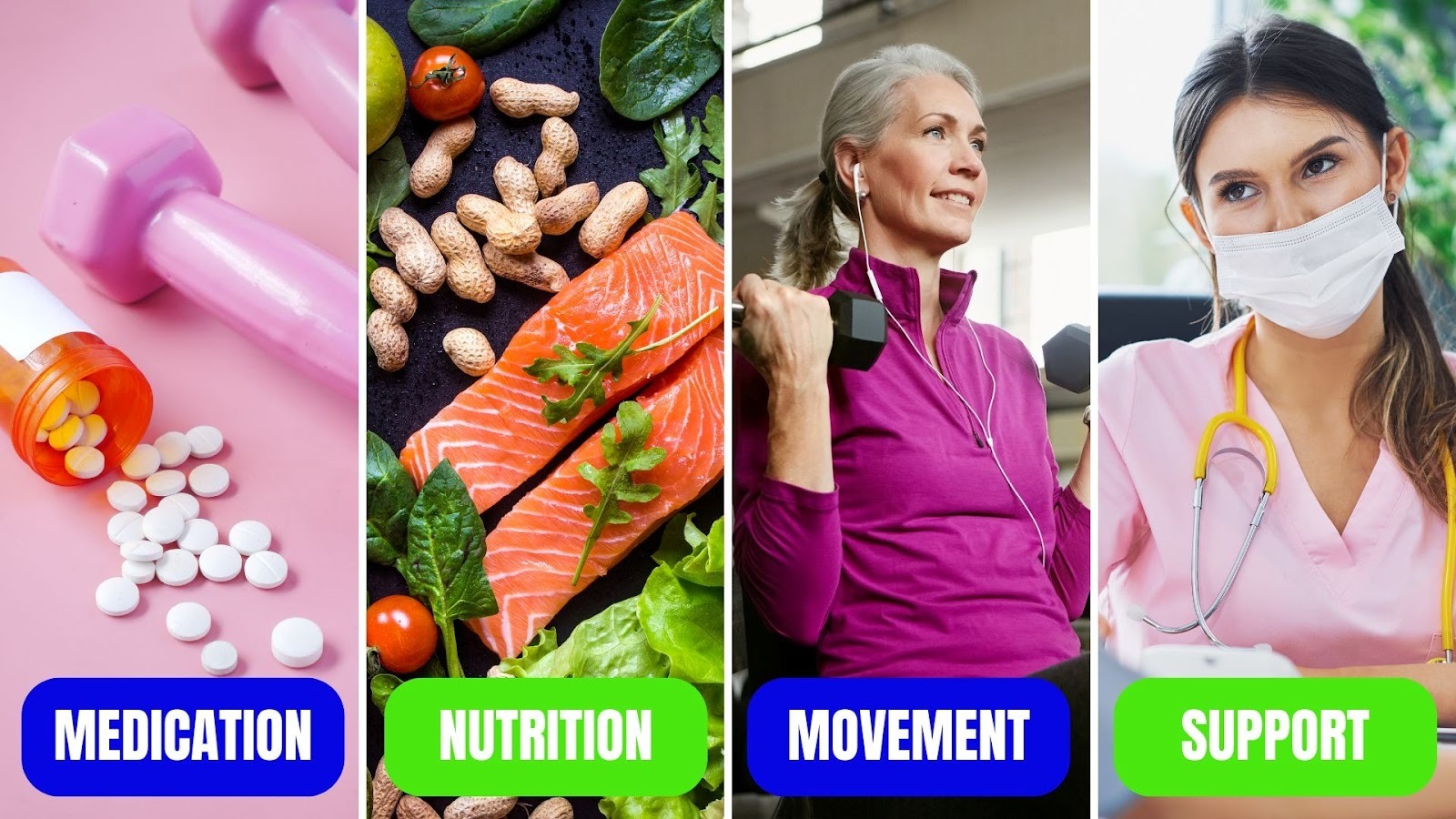
- Movimiento: Building Muscle, Protecting Metabolism
If medication is support and nutrition is fuel, movement is the engine.
Strength training is especially powerful after 50 because muscle is metabolically active tissue (as we’ve already learned, right!?) The more lean muscle you maintain, the stronger your resting metabolism stays.
Movement in our approach includes:
- Resistance training 2–4 times per week
- Daily activity (walking, mobility, light cardio)
- Progressive strength building
- Bone-supportive exercises
Cardio has benefits, but muscle-building is the true anti-aging strategy. Movement becomes less about burning calories and more about building a body that burns efficiently on its own.
- Apoyo: Accountability, Mindset and Community
This pillar is often the most underestimated and the most transformative.
Weight loss after 50 isn’t just physical. It’s emotional. It’s hormonal. It’s tied to stress, sleep, life transitions and decades of diet culture messaging.
Support includes:
- Medical supervision
- Ongoing accountability
- Education
- Encouragement
- Community
You don’t need more willpower. You need structure, guidance and a team that understands what your body is navigating.
Because when medication, nutrition, movement and support align, weight loss becomes less about fighting yourself and more about finally working with your body.
And that’s where real, lasting change begins.
Medical Support Options: Because Science Is on Your Side
For some women, lifestyle adjustments alone aren’t enough to overcome hormonal and metabolic shifts. That’s where medically supervised options can provide meaningful support.
Semaglutide
Semaglutide (the active ingredient in medications such as Wegovy® and Ozempic®) is a GLP-1 receptor agonist that helps regulate appetite and blood sugar. It works by slowing gastric emptying and increasing feelings of fullness, which can naturally reduce caloric intake without constant hunger.
For postmenopausal women dealing with insulin resistance or stubborn abdominal fat, semaglutide can be particularly helpful. However, it works best when paired with strength training and adequate protein to protect lean muscle mass.
It’s not a shortcut. It’s metabolic support.
Tirzepatide Shots
Tirzepatide builds on the GLP-1 mechanism by also targeting GIP receptors. This dual-action approach enhances appetite control and insulin sensitivity even further.
For women with more significant metabolic resistance, tirzepatide can be a powerful option under medical supervision. As with all medical weight loss tools, the focus remains on fat loss while preserving muscle and supporting overall metabolic health.
Recetas Phentermine
Phentermine is a short-term appetite suppressant that may be used for several weeks as part of a medically supervised weight loss program. It’s often used strategically to help patients build early momentum, which can be motivating and confidence-building.
When medically screened and monitored properly, it can serve as a temporary boost within a structured plan.
Lipo Shots
Lipo shots (lipotropic injections) typically include B vitamins, amino acids and compounds that support fat metabolism and energy production.
While they aren’t a standalone solution, they can complement a comprehensive program by supporting energy levels and metabolic function, especially during calorie reduction phases.

After 50, weight loss isn’t about shrinking yourself into a former version. It’s about supporting the body you have now.
Instead of asking, “Why doesn’t my body work like it used to?” try asking, “What does my body need now?”
This chapter is about:
- Strength over skinniness
- Fat loss over scale obsession
- Energy over exhaustion
- Sustainability over extremes
Your metabolism isn’t broken. It’s adapting. And when you meet it with science, strategy and self-compassion, change becomes possible again.
So… Can You Lose Weight After 50?
Duh! With realistic expectations, muscle-focused training, attention to body composition and (when appropriate) medical support, this can be one of your strongest, healthiest decades yet.
This isn’t the end of feeling vibrant.
It might just be the beginning.
Disclaimer: The information in this article is provided for educational and informational purposes only and is not intended to serve as medical advice, diagnosis, or treatment. Weight loss results vary and depend on many individual factors, including health status, lifestyle, and adherence to a treatment plan. Prescription medications and medical weight loss treatments should only be used under the supervision of a qualified healthcare provider.